


Gas and oil prices soar and shares tumble on fears conflict could escalate
Gas and oil prices soar and shares tumble on fears conflict could escalateShareSaveOsmond ChiaandNatalie Sherman,Business reportersShareSave

 Getty Images
Gas prices have spiked and global stock markets tumbled as the conflict in the Middle East intensified and concerns grew over how long it will last.
The UK gas price surged to its highest level for three years on Tuesday, following sharp gains on Monday, while Brent crude oil benchmark briefly rose above $85 a barrel for the first time since July 2024.
Meanwhile, the share prices of companies on US, European and Asian stock markets plunged.
Since Israel and the US launched strikes on Iran and Tehran retaliated, investors have been weighing the potential economic impact, including what it could mean for inflation and interest rates.
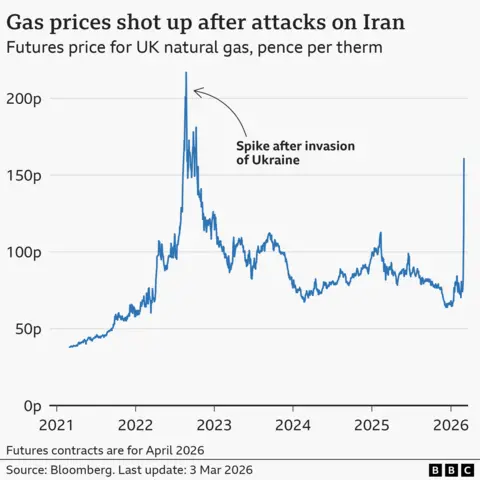
There are fears the fight in a region that plays a key role in global energy supplies and shipping routes could have a similar impact to Russia's full-scale invasion of Ukraine four years ago which pushed up the cost of energy, causing price rises for businesses and consumers around the world.
In its latest fiscal outlook document, the UK's Office for Budget Responsibility said the escalation of the conflict could upset its forecasts, warning it could have "very significant impacts on the global and UK economies".
German Chancellor Friedrich Merz, who met with Trump at the White House on Tuesday, also voiced concerns about economic damage.
"That's the reason why we all hope this war will come to an end as soon as possible," he said.
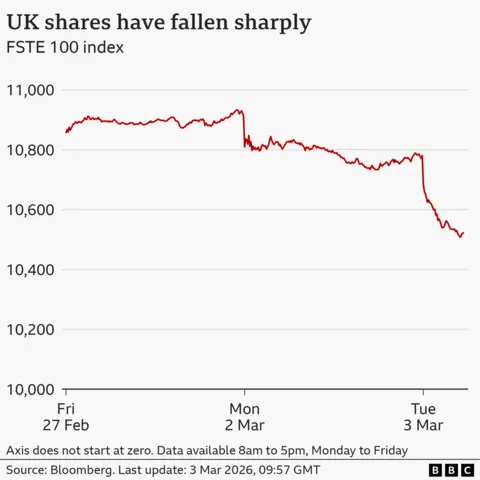
The FTSE 100 index of the largest firms listed in London fell 2.75% by the end of trading on Tuesday, while Germany and France's main indexes closed down 3.44% and 3.46% respectively.
In the US, the S&P 500 fell sharply at the open but recovered some of those losses, ending down 0.9%.
In Asia, Japan's Nikkei fell 3.3%. Hong Kong's Hang Seng and the Shanghai Composite in mainland China were also down. The Kospi in South Korea, which was shut for a public holiday on Monday, fell by more than 7%.
The benchmark UK gas price rose above 165p a therm on Tuesday, which it last traded at a year after the start of the Ukraine war. It closed at 138p a therm — still over a fifth higher than Monday's price.
UK gas prices have now doubled since the US and Israel began a wave of air strikes on Iran on Saturday.
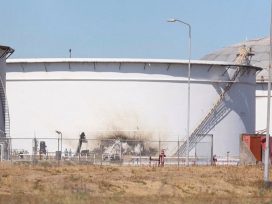
The spike in gas prices came after QatarEnergy, one of the world's biggest exporters, halted production following "military attacks" on its facilities.
It later said it would stop producing other materials including aluminium, methanol and urea used for fertiliser.
Higher gas prices could put pressure on household energy bills, although any impact would not be seen in the UK until July because a price cap has been put in place until then.
Oil prices have not risen as sharply as there is greater flexibility in sourcing additional crude compared to gas, though they are still much higher than on Friday.
Nevertheless, rising oil prices can affect the economy by making things such as motor fuel, transport and food more expensive.
If inflation — the pace of price rises — picks up, then this may make central banks less likely to cut interest rates in the months ahead.
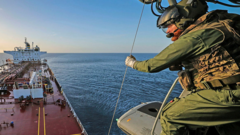
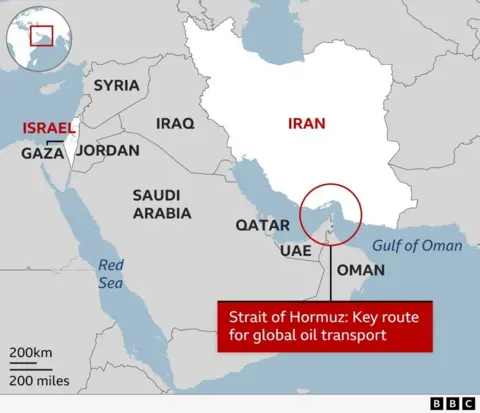
Shipping through the Strait of Hormuz is crucial to the global economy, with about 20% of the world's oil and gas passing through the waterway. But traffic has come to a halt after several vessels were attacked in recent days.
Ebrahim Jabbari, an adviser to the commander-in-chief of Iran's Islamic Revolutionary Guard Corps (IRGC), told state TV that ships "should not come to this region. They will certainly face a serious response from us".
As well as pushing up prices on global energy markets, the conflict has triggered a rise in how much it costs to transport oil.
Hiring a supertanker to move oil from the Middle East to China reached an all-time high on Monday of more than $400,000 (£298,300) per day, almost double the cost last week, according to data from the London Stock Exchange Group.
Sanne Manders, president of logistics technology platform Flexport, told the BBC the Strait of Hormuz was "effectively closed".
It is partly down to carriers not willing to take the risk, but also due to "insurance companies not being willing to insure this risk anymore", he told the Today programme.
He added that carriers were likely to start raising rates "for any shipping in the world" in anticipation of higher fuel prices.
UK households are also likely to see higher fuel prices if the cost of oil remains high, according to Alasdair Locke, chairman of Motor Fuel Group, the UK's largest independent forecourt operator.
"With the price of oil going up, that is inevitably going to feed through in due course to higher prices at the pump," he said.
"It will depend on how long and how high those prices go as to how high the price of fuel will be."