Japanese people brave snow to vote in snap election ShareSaveKelly NgandShaimaa Khalil,Tokyo correspondentShareSave
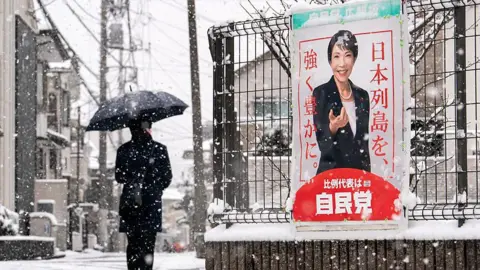
Japanese people are braving the snow to vote in a snap election called by Prime Minister Sanae Takaichi, whose coalition is predicted to clinch a decisive win.
Takaichi called the country's first mid-winter poll in 36 years to seek a public mandate soon after winning her party's leadership race last October.
Some called the move a gamble given her Liberal Democratic Party (LDP) had lost its majority in both houses of parliament, and its decades-old coalition with the Komeito party had collapsed.
An LDP-led coalition has governed Japan for much of its post-war history due to the lack of a strong opposition. But recent corruption scandals had pummelled its image before Takaichi took office.

 Getty Images
Her personal popularity appears to have helped the party, with approval ratings for her government mostly hovering above 70%. And the polls have given the LDP's current coalition with the Japanese Innovation Party up to 300 of the 465 seats in the lower house.
This is a turnaround for a party whose last two leaders had to step down before finishing their terms as prime minister after a fundraising scandal, plummeting ratings and election losses.
"People want their lives to be better and more comfortable because we are so accustomed to not having inflation [costs rising]… so people are very worried. I think we need a long-term solution rather than short-term fixes," Ritsuko Ninomiya, a voter in Tokyo told the BBC.
Japanese voters have been frustrated with the recent political scandals in the LDP, especially as costs soared.
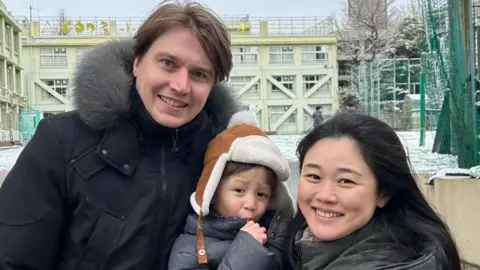
"Housing is very expensive," says Rumi Hayama. "Our son is getting bigger and we need a bigger place but it is not affordable although we have decent jobs. Prices are getting higher and [it is] getting hard to live in Japan. It was not like this before."
 Chika Nakayama/BBC
Takaichi's enthusiasm, populist spending promises and nationalist rhetoric appear to have energised some voters. But critics, including businesses, are sceptical that her pledge to spend more can revive the sluggish Japanese economy. The country's government debt is already one of the highest among developed nations. They also worry that her conservative stance on immigration will not help the ageing country which is already facing labour shortages.
"I think this election is more important for the younger generation, people like us," Daniel Hayama says, adding that the cold weather is not a hurdle for young people who want to vote.
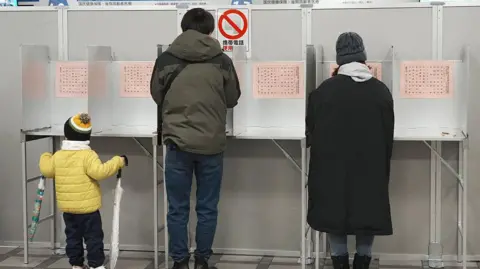
But snow is expected to disrupt voter turnout, especially in the northern and eastern regions. Turnout for early voting this time, which was reported to be nearly 4.6 million people, was down 2.5% from the last election in 2024. The drop has been attributed to the weather.
Several areas, including Niigata Prefecture in central Japan, reported heavy snow on Sunday. Japan's transport ministry said 37 train lines and 58 ferry routes were closed and 54 flights cancelled as of Sunday morning. There was rare snowfall in Tokyo as people headed out to vote.
 Getty Images
Takaichi and the LDP face a more unified opposition than before. LDP's former coalition partner Komeito has joined forces with the Constitutional Democratic Party of Japan to form the largest opposition bloc in the lower house.
And not everyone is convinced Takaichi's popularity will translate into votes.
"This is not a presidential election but a parliamentary election, in which the LDP's candidates are mostly men tainted by past scandals," political science professor Koichi Nakano, from Sophia University, told the BBC.
The government's policy package may offer households short-term relief, but "fails to address the underlying problems of weak productivity and stagnant real wages", Masahiko Takeda, a senior fellow focusing on Asia at the Australian National University, wrote in an article this week.
Moreover, Takaichi has dug herself into "a deep hole in foreign and security policy by antagonising China", Nakano added.
Takaichi angered Beijing, Tokyo's largest trading partner, late last year with her suggestion that Japan could respond with its own self-defence force if China attacked Taiwan.
Tokyo's relationship with Washington, its closest ally, is also facing uncertainty under an predictable Trump presidency, although the US has lowered the 25% tariffs it initially threatened to impose to 15%.
 Chika Nakayama/BBC
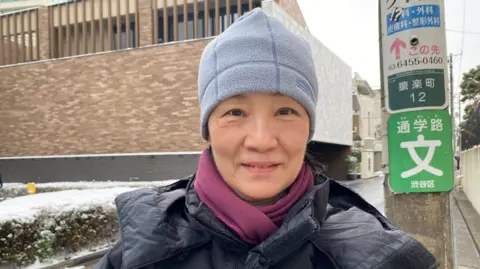
"I think the world is changing so much with Trump in office and all… so peace is even more important now," Ms Hattori told the BBC.
Takaichi has courted Trump and has even been publicly endorsed by him – an unusual move by a US president – and they both seem to agree that Japan should spend more on defence. That relationship too was on voters' minds as they headed to the polls on Sunday.
"I am concerned with what President Trump is doing as well as the national defense issues. I am not sure where the money is coming from to cover that. So balancing budget spending between defence and people's life is a major concern for me," Yuko Sakai says.
Additional reporting by Chika Nakayama